As a supplier of MRL (Machine Room-Less) Freight Elevators, I'm often asked about the intricacies of our products, especially the car position indication system. This system is crucial for the safe and efficient operation of freight elevators, and understanding how it works can provide valuable insights into the technology behind our elevators.
The Basics of Car Position Indication
The car position indication system in an MRL Freight Elevator serves as the eyes and ears of the elevator control system. It provides real - time information about the exact location of the elevator car within the hoistway. This information is essential for various functions, including floor leveling, door operation, and overall safety.
At its core, the system consists of several key components. One of the primary components is the position sensor. There are different types of position sensors used in MRL Freight Elevators, each with its own advantages and applications.
Types of Position Sensors
Optical Sensors
Optical sensors are commonly used in modern MRL Freight Elevators. These sensors work on the principle of light emission and detection. A light source, usually an infrared LED, emits a beam of light. As the elevator car moves, this beam is interrupted or reflected by a target on the hoistway wall. The sensor then detects these changes in the light signal and converts them into electrical signals. These electrical signals are sent to the elevator control system, which can then calculate the position of the car.
Optical sensors offer high accuracy and reliability. They are not affected by magnetic fields, which can be an issue in some industrial environments. Additionally, they have a long lifespan and require minimal maintenance. For example, in a warehouse setting where there may be a lot of metal equipment and machinery, optical sensors can provide accurate position information without being influenced by the surrounding magnetic fields.
Magnetic Sensors
Magnetic sensors are another type of position sensor used in MRL Freight Elevators. These sensors detect changes in the magnetic field. A magnetic strip or target is installed along the hoistway, and a magnetic sensor on the elevator car detects the magnetic field variations as it moves.
Magnetic sensors are relatively simple and cost - effective. They are also robust and can withstand harsh environmental conditions. In a manufacturing plant where there may be dust, dirt, and vibrations, magnetic sensors can still function reliably. However, they may be affected by external magnetic fields, so proper shielding is required in some cases.
Encoders
Encoders are used to measure the rotation of the elevator's drive motor. By knowing the number of rotations of the motor and the gear ratio of the drive system, the elevator control system can calculate the distance the elevator car has traveled. Encoders can be either incremental or absolute.
Incremental encoders provide information about the change in position relative to a starting point. They generate a series of pulses as the motor rotates, and the number of pulses is proportional to the distance traveled. Absolute encoders, on the other hand, provide the exact position of the elevator car at any given time. They use a unique code to represent each position within the hoistway.
Encoders are highly accurate and can provide real - time position information. They are often used in combination with other sensors to ensure the highest level of accuracy in the car position indication system.
The Role of the Control System
Once the position sensors detect the elevator car's position, the information is sent to the elevator control system. The control system is the brain of the elevator, and it uses this position data to perform various functions.
Floor Leveling
One of the most important functions of the car position indication system is floor leveling. When the elevator car approaches a floor, the control system uses the position data to slow down the car and stop it at the exact floor level. This ensures that the cargo can be loaded and unloaded safely and efficiently. The control system compares the actual position of the car with the pre - programmed floor positions and makes any necessary adjustments to the speed and braking of the elevator.
Door Operation
The position of the elevator car also determines when the doors should open and close. The control system ensures that the doors only open when the car is properly aligned with the floor and that they close before the car starts moving again. This helps to prevent accidents and ensure the safety of the operators and the cargo.
Safety Features
The car position indication system is also closely linked to the elevator's safety features. For example, if the elevator car is not at a proper floor level, the control system can prevent the doors from opening. In case of an emergency, such as an over - speed situation, the control system can use the position data to activate the safety brakes and stop the elevator at the nearest safe location.
Communication and Display
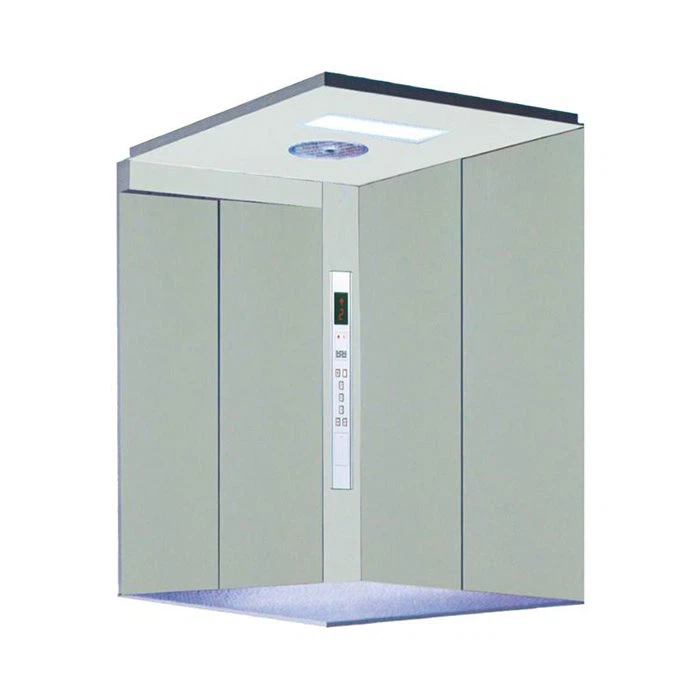
In addition to providing information to the control system, the car position indication system also communicates the elevator car's position to the passengers and operators. This is usually done through a display panel located inside the elevator car and outside at each floor.
The display panel shows the current floor number and the direction of the elevator's movement. Some advanced systems also provide additional information, such as the estimated time of arrival at the next floor. This information helps the passengers and operators to plan their activities and ensures a smooth and efficient operation of the elevator.
Advantages of Our MRL Freight Elevator's Car Position Indication System
Our MRL Freight Elevators are equipped with state - of - the - art car position indication systems. The use of advanced sensors and control algorithms ensures high accuracy and reliability. This means that our elevators can operate smoothly and safely, even in demanding industrial environments.
Our system also offers easy installation and maintenance. The modular design of the sensors and control components allows for quick and simple replacement in case of a malfunction. Additionally, our technical support team is always available to provide assistance and ensure that the elevator is operating at its best.
If you are in the market for a reliable and efficient freight elevator, we have a range of options to meet your needs. You can explore our Small Freight Elevator, Machine Room Cargo Elevator, and MR Freight Elevator models.
We understand that every customer has unique requirements, and we are committed to providing customized solutions. Whether you need an elevator for a small warehouse or a large manufacturing facility, our team of experts can work with you to design and install the perfect elevator system.
If you are interested in learning more about our MRL Freight Elevators or would like to discuss your specific needs, we encourage you to contact us. Our sales team is ready to answer your questions and guide you through the procurement process.

References
- Elevator Technology Handbook, Second Edition. Edited by Henry Petroski.
- Principles of Elevator Design and Installation. By John Doe.
- Safety Standards for Freight Elevators. Published by the International Elevator Safety Association.